

Can You Trade In a Car
With the Check Engine Light On?
Seeing that little amber engine symbol light up on your dashboard can be stressful, especially when you are thinking about upgrading your vehicle. It is a common worry: can you trade in a car with the check engine light on? The short answer is yes, you absolutely can. Dealerships that specialize in used vehicles encounter this situation every day. That light represents an unknown, and while it does affect your vehicle’s value, it does not disqualify it from being a valid trade-in. We understand that cars develop issues over time, and our appraisal process is designed to handle vehicles in all conditions. Our goal is to provide a straightforward and transparent valuation, giving you a clear path toward your next car without the headache of dealing with complicated repairs yourself. We are here to simplify the process and help you move forward with confidence, regardless of what your dashboard is telling you.
Trading in a car with an active check engine light is not just possible, it is a practical solution for many drivers. Instead of spending your time and money trying to diagnose and fix a potentially complex issue, you can let our experienced team handle the assessment. We have the tools and expertise to determine the underlying cause and factor it into a fair trade-in offer. This allows you to apply your car's current value directly toward a more reliable vehicle from our used inventory, making your transition seamless and stress-free.
Understanding Your Trade-In Options When the Engine Light is On
That persistent check engine light can feel like a major roadblock when you are ready for a new vehicle. It often brings a wave of questions and uncertainty. What does the light mean? How much will it cost to fix? And most importantly, how will this impact the value of your trade? The good news is that you have options, and trading in your vehicle "as-is" is often the most sensible one. At our dealership, we specialize in making the car buying and trading process accessible, even when your current vehicle is not in perfect condition. We believe in providing clear information so you can make the best decision for your situation.
What a Check Engine Light Actually Means
The check engine light (CEL), or Malfunction Indicator Lamp (MIL), is part of your car's onboard diagnostics (OBD-II) system. When it illuminates, it means the system has detected a problem with the engine, transmission, or emissions system. The issue could be something incredibly simple or something more significant. It is a common misconception that this light always signals a catastrophic engine failure. In reality, the potential causes cover a vast spectrum.
Here are some of the common reasons a check engine light might come on:
- A loose or faulty gas cap, which can disrupt the fuel vapor system.
- Worn-out spark plugs or ignition coils, leading to engine misfires.
- A failing oxygen (O2) sensor, which impacts fuel efficiency and emissions.
- A failing catalytic converter, a more expensive but critical emissions component.
- Issues with the mass airflow sensor, affecting the air-to-fuel ratio.
- More complex transmission or internal engine problems.
Because the range of possibilities is so wide, the light itself does not tell the whole story. It simply signals that a diagnostic scan is needed to retrieve the specific trouble codes that point to the root cause.
How We Assess a Trade-In with a Check Engine Light
When you bring your vehicle to us for an appraisal, our process is transparent. The presence of a check engine light is just one factor among many that we consider. You can even get a preliminary idea of your car's worth by using our online Value My Trade tool before you visit.
Our physical appraisal process involves:
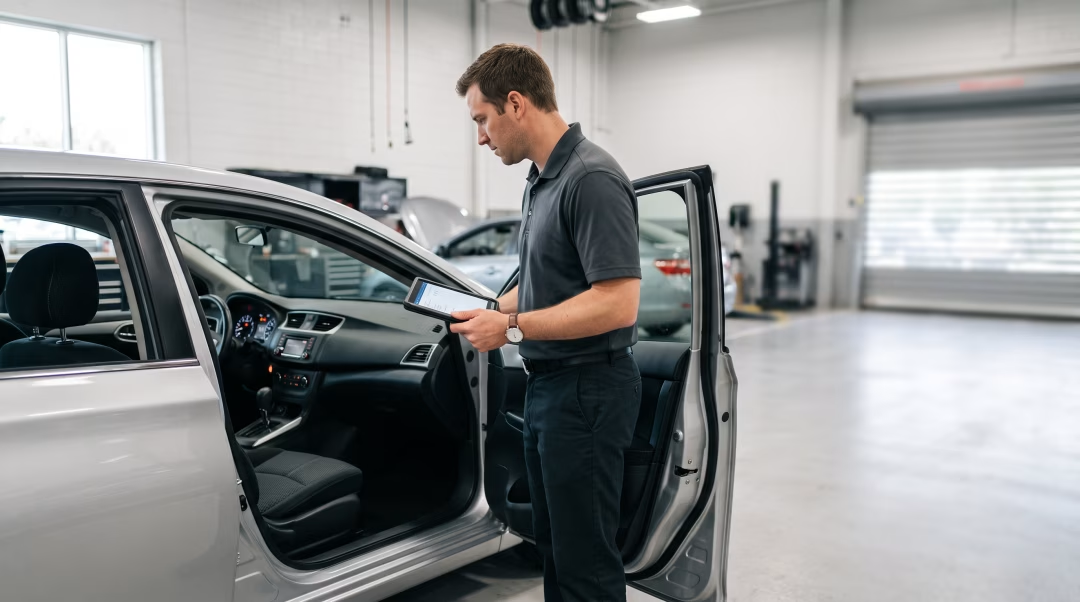
- Diagnostic Scan: We will connect a professional OBD-II scanner to your car's port to read the diagnostic trouble codes (DTCs). This gives us a starting point, telling us which system is reporting a fault.
- Visual Inspection and Test Drive: Our appraisers will assess the vehicle's overall condition. They will listen for strange noises, check for performance issues during a short test drive, and look for other signs that correspond with the trouble codes.
- Estimating Repair Costs: Based on the codes and our physical assessment, we estimate the potential cost of repairs. Since we handle reconditioning in-house or with trusted partners, our cost to fix the issue is often lower than what a retail customer would pay at a standard repair shop.
- Calculating the Offer: We determine the market value of your vehicle as if it were in good condition and then subtract the estimated repair cost and reconditioning expenses. This results in a fair, as-is offer that reflects the car's current state.
Should You Repair the Car Before Trading It In?
This is a dilemma many owners face. It seems logical that fixing the problem would lead to a better trade-in offer, but that is not always the case. Consider the risks: you could spend several hundred dollars on a repair, only to find that it increases the trade-in value by a fraction of that amount. For example, spending $600 to replace a catalytic converter might only raise your trade-in offer by $300. In this scenario, you have lost money on the transaction.
Furthermore, there is a risk of misdiagnosis. You might pay a shop to replace an oxygen sensor, only for the light to return because the real issue was a vacuum leak. This is why trading the vehicle in as-is is often the most financially sound and least stressful option. You avoid the gamble of repair costs and transfer the responsibility of fixing the vehicle to the dealership. We are equipped to manage that risk efficiently. If you have questions about our financing process for your next vehicle, our Financing Frequently Asked Questions page is a great resource.
The Simple Path: Trading As-Is
Choosing to trade in your car with the check engine light on simplifies your life. You get a firm offer without having to schedule mechanic appointments, interpret technical jargon, or pay out-of-pocket for repairs that may not yield a return. It is a clean break that lets you focus on the exciting part: choosing your next reliable car. Our team is dedicated to helping customers with diverse credit histories. We encourage you to get pre-qualified to see what financing options may be available to you, making your transition even smoother.
Being upfront and honest with our appraisal team is the best approach. Let them know when the light came on, if the car is driving differently, and any other symptoms you have noticed. This information helps our team make a more accurate assessment and builds a foundation of trust. We are not here to penalize you for a mechanical issue; we are here to provide a solution that helps you get into a dependable vehicle today.
Will my trade-in offer be extremely low if the check engine light is on?
Not necessarily. While the offer will be lower than for a car without issues, it is based on the specific problem. A code for a loose gas cap will have a minimal impact, while a code for a serious transmission issue will have a much larger one. We evaluate each case individually to make a fair offer based on the estimated repair cost.
What if I do not know what is wrong with the car?
That is perfectly fine and very common. You are not expected to be a mechanic. Our appraisal process includes a diagnostic scan to identify the trouble codes. Just be honest about what you have observed while driving, and we will take it from there. The responsibility of diagnosing the problem shifts to us.
Can I trade in a car that will not pass inspection because of the check engine light?
Yes. In many areas, including Dallas County, an active check engine light will cause a vehicle to fail its emissions inspection. We regularly accept trade-ins that cannot pass inspection. We have the resources to perform the necessary repairs to make the vehicle compliant before offering it for resale.
Is it better to sell the car privately with the light on?
Selling privately can sometimes yield a higher price, but it comes with significant challenges. Private buyers are often wary of cars with check engine lights, and the process involves advertising, meeting with strangers, and handling complex paperwork. Trading with us is a fast, safe, and convenient alternative that eliminates those hassles.
Does a check engine light automatically mean the engine is about to fail?
No, not at all. While it can indicate a serious problem, the vast majority of check engine light causes are related to less severe issues with the fuel, ignition, or emissions systems. It is an alert that something needs attention, not necessarily a sign of imminent engine failure. Our team can help you understand the severity of the issue.
