

How to Check Tire Condition on
a Used Car: A Complete Guide
When you are exploring our used inventory, one of the most critical components to inspect is the set of tires. They are your only connection to the road, directly impacting safety, handling, and fuel economy. The condition of the tires can also be a revealing clue about the vehicle’s maintenance history and potential underlying issues with its suspension or alignment. A car with new, quality tires is a good sign, but worn, mismatched, or damaged tires can mean an immediate and significant expense right after your purchase. Taking just a few minutes to learn how to properly check the tire condition on a used car can save you hundreds of dollars and provide invaluable peace of mind. This guide will walk you through the simple, effective steps to becoming a savvy tire inspector, empowering you to make a more informed and confident buying decision.
While a quick glance might tell you if a tire is flat, it will not reveal the more subtle but equally important details about its health and longevity. Understanding what to look for, from tread depth and wear patterns to the tire’s age and sidewall integrity, gives you a much clearer picture of the vehicle’s true condition. Below, we dive deep into the specific techniques and warning signs that every used car buyer should know before they schedule a test drive.
Your In-Depth Guide to Inspecting Used Car Tires
Tires are more than just black rubber circles; they are a complex and vital safety system. Neglecting to inspect them thoroughly is a common mistake that can lead to unforeseen costs and compromised safety. The cost of a new set of four tires can easily run from several hundred to over a thousand dollars, depending on the vehicle. By learning to assess them yourself, you can factor this potential cost into your negotiation or simply choose a vehicle that has been better maintained. This detailed inspection process is a crucial step before you even begin to think about our financing area.
The First Step: Checking Tire Tread Depth
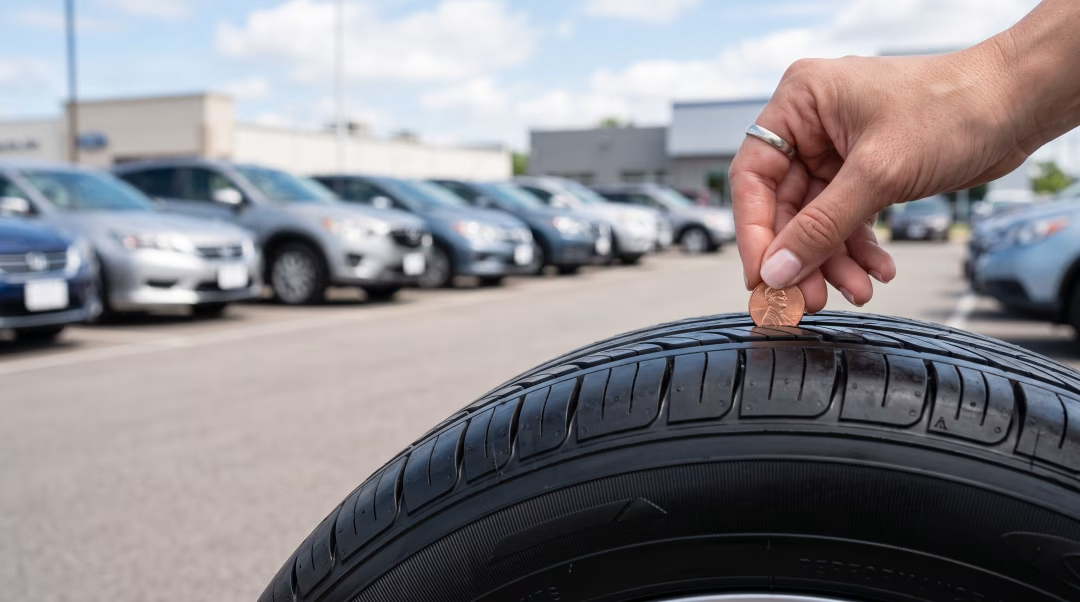
Tire tread is essential for maintaining grip, especially in wet or adverse conditions. The grooves in the tire are designed to channel water away from the contact patch, preventing hydroplaning. As the tread wears down, this ability diminishes significantly. The easiest way to check tread depth is with the classic "penny test."
- Take a standard U.S. penny and place it upside down, with Lincoln's head facing you, into several of the tire’s tread grooves.
- If you can see the top of Lincoln's head, the tread is worn down to approximately 2/32 of an inch or less. This is the legal minimum in most states, including Texas, and means the tires need to be replaced immediately.
- If the tread covers part of Lincoln's head, you have more than 2/32 of an inch remaining. For a better buffer, you can use a quarter. If the tread touches Washington's head, you have at least 4/32 of an inch, which is a safer margin.
Be sure to check the tread depth across the entire width of the tire—the inside, middle, and outside—as uneven wear can indicate other problems.
Decoding the Story of Uneven Tire Wear
How a tire wears tells a story about the car's alignment, suspension, and inflation history. Perfectly even wear across the tread is the ideal scenario. If you see specific patterns, it could be a red flag for issues that go beyond the tires themselves. You will want to watch for signs your car needs a wheel alignment during your test drive if you notice these patterns.
- Center Wear: If the center of the tread is more worn than the edges, it is a classic sign of over-inflation. The previous owner likely kept the tires inflated beyond the manufacturer's recommendation.
- Edge Wear: When both outer edges of the tire are more worn than the center, it typically indicates chronic under-inflation.
- Cupping or Scalloping: This appears as a pattern of diagonal, scooped-out patches on the tire. It is often a sign of worn-out shocks, struts, or unbalanced wheels, suggesting the suspension system may need attention.
- One-Sided Wear: Significant wear on just the inner or outer shoulder of the tire is a strong indicator of a wheel alignment problem (specifically, camber or toe issues).
A Close Look at the Sidewalls: Spotting Hidden Dangers
The sidewall provides the structural integrity of the tire. Damage here is often more serious than a simple puncture in the tread. Run your hands carefully over the entire sidewall of each tire (when the car is parked and cool) and look closely for any of these issues:
- Cracks: Fine cracks or crazing, especially between the tread blocks or on the sidewall, indicate the rubber is aging and drying out. This is known as "dry rot" and significantly weakens the tire.
- Bulges or Bubbles: A bulge on the sidewall means the tire’s internal structure has been damaged, likely from hitting a pothole or curb. Air is leaking through the inner liner and getting trapped. This is a blowout waiting to happen and is extremely dangerous.
- Cuts or Gouges: Deep cuts that may have damaged the internal cords of the tire are a serious concern. If you can see fabric or metal cords, the tire is unsafe to drive on.
How Old Are These Tires? Reading the DOT Date Code
Even a tire with excellent tread can be unsafe if it is too old. The rubber compounds break down over time due to exposure to the elements and oxygen, regardless of mileage. To check the age, you need to find the DOT code on the sidewall. It is a series of letters and numbers that ends in a four-digit code. For a more detailed explanation, learn how to read the tire date code. The last four digits represent the week and year the tire was manufactured. For example, a code of "3521" means the tire was made in the 35th week of 2021. Most manufacturers recommend replacing tires after 6 to 10 years, no matter how much tread is left. Old tires are a significant safety risk.
Searching for Previous Repairs and Mismatched Tires
Look over the tread and sidewalls for signs of past repairs. A proper patch is applied from the inside and is difficult to see, but a "plug" is a rubber strip inserted from the outside and is often visible. While plugs can be a temporary fix, they are not considered a permanent or ideal repair. Also, check to see if all four tires are the same brand, model, and size. Mismatched tires can negatively affect a vehicle's handling, stability, and the performance of its all-wheel-drive or traction control systems. At a minimum, the two tires on each axle should be a matching pair.
Do Not Forget the Spare
Finally, do not forget to check the spare tire. Locate it in the trunk, under the vehicle, or on the back gate. Check its air pressure and inspect it for age and damage just as you did with the other tires. A spare that is flat, rotted, or missing is useless in an emergency. Also, confirm that the jack and lug wrench are present and in working order. Knowing how to properly inspect the tires can help you budget for car maintenance more effectively from day one of ownership.
What is the minimum legal tread depth for tires in Texas?
In Texas, the minimum legal tire tread depth is 2/32 of an inch. You can easily check this with the penny test; if you can see all of Abraham Lincoln's head when the penny is placed upside down in the groove, the tire is at or below the legal limit and needs immediate replacement.
How old is too old for a tire, even if the tread looks good?
Most vehicle and tire manufacturers recommend replacing tires every 6 to 10 years, regardless of tread depth. The rubber compounds degrade over time due to exposure to heat, UV rays, and oxygen, which can lead to cracking and an increased risk of failure. You can find the manufacture date by reading the last four digits of the DOT code on the sidewall.
Is it a deal-breaker if a used car has mismatched tires?
It is not necessarily a deal-breaker, but it is a point for negotiation and a sign of potentially deferred maintenance. Having four matching tires is ideal for performance and safety. If the tires are mismatched, you should at least ensure that the two tires on each axle are a matching pair. The cost of replacing them to match should be factored into your offer.
Can I ask the dealership to replace the tires on a used car?
Yes, you can certainly make it a condition of the sale. If your inspection reveals that the tires are worn out, dangerously old, or damaged, it is reasonable to ask the dealer to replace them before you finalize the purchase. This is a common point of negotiation when buying a used vehicle.
What does a bubble or bulge on the tire sidewall mean?
A bubble or bulge on the sidewall is a very serious safety hazard. It indicates that the internal structure of the tire has been compromised, usually from an impact like hitting a curb or a deep pothole. Air is leaking through the inner liner, creating the bulge. This tire is at high risk of a sudden blowout and must be replaced immediately.
