

What Size Used SUV
Fits in a Standard Garage?
Will Your Next SUV Fit? The Garage Parking Guide
Finding the perfect used SUV involves balancing space, features, and budget. But there is one crucial question many buyers overlook until it is too late: will it actually fit in my garage? That moment of realization, when a beautiful new-to-you vehicle is too long, wide, or tall for your space, is a frustration you can easily avoid. This guide is designed to help you navigate the world of SUV dimensions and standard garage sizes. By understanding the typical measurements of both garages and different SUV classes, from compact crossovers to full-size models, you can shop with confidence. Preparing with a tape measure and a little knowledge ensures that your chosen vehicle will not only serve you on the road but will also have a safe and secure home. Explore our used inventory knowing you will find a vehicle that is the perfect fit for your life and your garage.
Measure Twice, Buy Once
The key to a successful purchase is preparation. Before you even schedule a test drive, take a few minutes to measure your garage's usable depth, width, and entry height. Remember to account for shelving, storage, and the space needed to open doors. Comparing these real-world numbers to the specifications of the SUVs you are considering is the single most effective way to prevent a costly and inconvenient mistake. Our team is always here to help you find the exact dimensions for any vehicle on our lot.
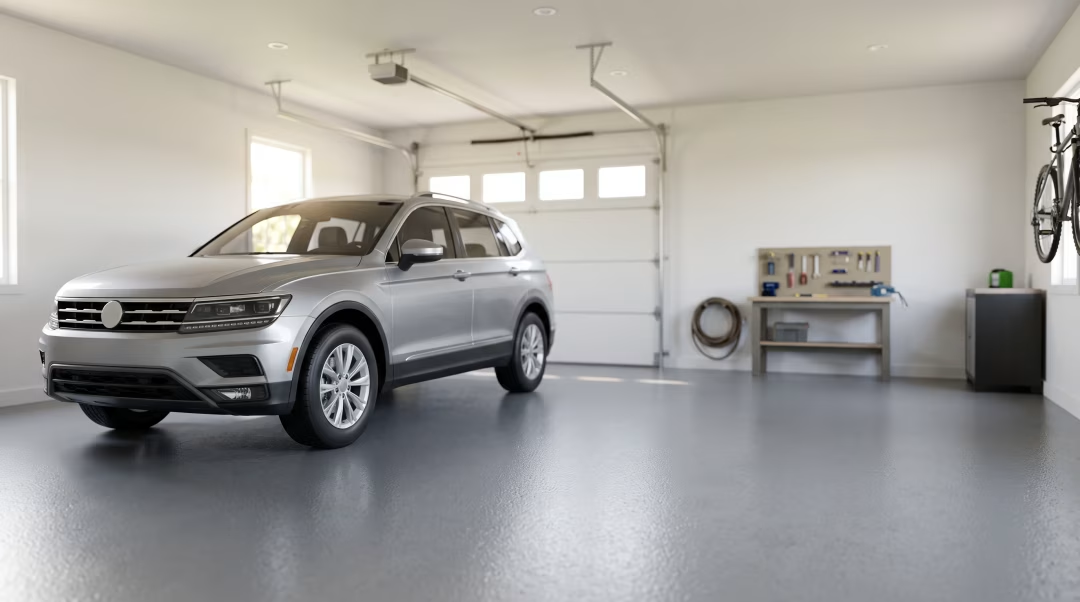
A Detailed Look at SUV Sizes and Garage Dimensions
The Sport Utility Vehicle has become a dominant force on the road, offering unparalleled versatility for families, adventurers, and daily commuters. Yet, this versatility comes in a wide array of sizes. One of the most practical considerations in your search is ensuring your new vehicle fits comfortably within your garage. Let's break down the details so you can make an informed decision and avoid any parking surprises.
Understanding "Standard" Garage Sizes
The term "standard garage" can be misleading, as dimensions have evolved over the decades. Homes built in the 1950s and 60s often had smaller garages designed for narrower, shorter cars. Modern homes typically feature more generous proportions, but variations are still common. It is always best to measure your specific space.
- One-Car Garage: A common size is approximately 12 feet wide by 20 feet deep. The garage door opening is typically 8 or 9 feet wide and 7 feet high.
- Two-Car Garage: These usually range from 18 to 20 feet wide and 20 to 22 feet deep. The garage door might be a single 16-foot wide door or two separate 8 or 9-foot doors. The height remains a standard 7 feet in most cases.
- The Critical Measurement: While depth and width are important, the garage door's opening height is often the most restrictive dimension, especially for taller SUVs or those with roof racks.
Sizing Up the SUVs: A Class-by-Class Guide
SUVs are generally categorized into compact, mid-size, and full-size. Each class has a typical range of dimensions that directly impacts how it will fit in your garage. Whether you are looking for the best used SUVs for families or a nimble commuter, size matters.
Compact and Crossover SUVs
These are the smallest of the SUV family and are typically built on car platforms. Think of models like the Ford Escape, Honda CR-V, and Toyota RAV4. Their dimensions make them an excellent choice for almost any garage, including those in older homes.
- Length: Typically 175 to 185 inches (about 14.5 to 15.5 feet).
- Width: Around 70 to 75 inches (about 6 feet) without mirrors.
- Height: Usually 65 to 68 inches (about 5.5 feet).
With these measurements, a compact SUV will comfortably fit in a standard 20-foot deep garage, leaving plenty of room to walk around both the front and back.
Mid-Size SUVs
This is the most popular and diverse category, featuring models like the Ford Explorer, Jeep Grand Cherokee, and Toyota Highlander. They offer more interior space and often a third row of seating. This is the point where taking careful measurements becomes essential.
- Length: Generally 190 to 200 inches (about 16 to 16.7 feet).
- Width: Roughly 75 to 78 inches (6.2 to 6.5 feet) without mirrors.
- Height: Often 68 to 72 inches (5.7 to 6 feet).
A mid-size SUV will still fit in a standard 20-foot deep garage, but the buffer space for walking around will be significantly reduced. Width can also become a factor in a single-car garage, especially when considering the room needed to open doors.
Full-Size SUVs
These are the largest passenger vehicles on the road, often sharing a platform with pickup trucks. Models include the Chevrolet Tahoe, Ford Expedition, and Cadillac Escalade, along with their extended-length versions like the Suburban and Expedition MAX. These vehicles demand the most garage space. For many drivers needing to haul or tow, comparing a half-ton vs three-quarter-ton truck is a similar process.
- Length: Standard models are 205 to 215 inches (17 to 18 feet). Extended models can exceed 225 inches (nearly 19 feet).
- Width: Over 80 inches (6.7 feet) without mirrors.
- Height: Can be 75 inches (6.25 feet) or more, especially with 4x4 packages.
A standard full-size SUV will be a very tight fit in a 20-foot garage, leaving minimal room. An extended-length model like a Suburban will simply not fit in most standard garages. Height is also a major concern, as some models may challenge a 7-foot (84-inch) garage door opening.
Your Action Plan: How to Measure for Success
Before you fall in love with a vehicle, take these steps to confirm it is a good fit for your home.
- Measure Garage Depth: Use a tape measure to get the distance from the inside of your garage door to the back wall. Do this on both sides. If you have steps, a workbench, or storage cabinets, measure from the garage door to that obstruction.
- Measure Garage Width: Measure the wall-to-wall width. For a two-car garage, measure the space for each vehicle. Crucially, open the door of your current car to its widest comfortable point and measure that distance. You need enough space to exit the vehicle without hitting a wall or the other car.
- Measure Entry Height: This is the most forgotten measurement. Measure from the floor to the lowest point of the open garage door frame or the garage door itself when fully open. Sometimes the garage door opener track hangs down and is the lowest point.
- Get Vehicle Dimensions: You can find the exact specifications for any vehicle in our used inventory online, or you can simply contact us, and our team will provide them for you. Pay attention to length, width (with and without mirrors), and height.
- Allow a Buffer Zone: Never plan for a perfect fit. You should aim for at least 24-36 inches of clearance in length to walk around the vehicle and at least 24 inches on the driver's side to open the door comfortably.
Finding the Right Financing
Once you have found the right-sized used SUV, the next step is securing the right financing. Our team specializes in helping drivers navigate their options. You can start the process from home and get pre-qualified to understand your potential budget. This is different from a final approval, but it is a great first step. To see how your current vehicle can help, use our tool to value my trade. Our entire process is explained in our financing area, where we answer common questions and provide clarity on how in-house financing works.
What are the typical dimensions of a standard one-car garage?
A standard one-car garage is usually around 12 feet wide and 20 feet deep. The garage door opening is the most important measurement, which is typically 9 feet wide and 7 feet (84 inches) high. Older homes may have smaller dimensions.
How much extra space should I leave around my SUV in the garage?
For comfortable use, you should plan for at least 2 to 3 feet of space in front of or behind your vehicle to walk by easily. On the sides, you need enough room to open your doors without hitting the wall or another vehicle, so a minimum of 2 feet on the driver's side is recommended.
Do vehicle width specifications include the side mirrors?
Most manufacturers list the vehicle's width without accounting for the side mirrors. You often need to find a separate "width with mirrors" specification, which can add 8-12 inches to the total width. This is a critical detail for tight garage spaces.
Can a full-size SUV like a Chevy Suburban fit in a standard garage?
It is highly unlikely. An extended-length SUV like a Suburban is over 225 inches long (18.75 feet), which leaves almost no room in a 20-foot deep garage. A standard-length Tahoe or Expedition is already a very tight fit. Always measure your specific garage depth before considering these models.
Where can I find the exact dimensions of a used SUV I am interested in?
The easiest way is to check the vehicle details page on our website. You can also contact our dealership directly. Our sales staff are happy to look up the exact length, width, and height for any vehicle in our inventory to help you confirm it will fit your space.
